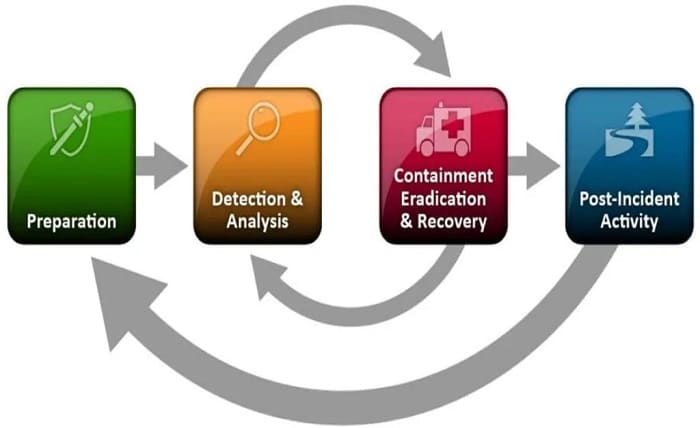
Modern applications are run in environments that are always changing. These environments use cloud computing, Kubernetes, microservices and continuous deployment pipelines. These technologies help get software to users.. They also increase the chance of problems happening. These problems can be when a service is down and an application fails there are security issues. The infrastructure is disrupted. How quickly and well we respond to these problems is very important for the business to keep running and for customers to trust the business. People who are learning about DevOps should know about incident response practices. This is a skill for working with systems that are being used and for reducing the impact of failures.
In DevOps incident response is a process. This process helps engineering teams find problems, figure out what is going on, contain the issue, fix it and learn from it. Smart companies make plans to prevent a messy and uncoordinated response to problems. They automate tasks. Help different teams work together like development, operations, security and business teams. A good incident response plan gets services back faster and makes the system more reliable in the long run. This is very important for DevOps training.
Develop a Structured Incident Response Process
A good incident response starts long before there is a problem. Companies should have a plan for incident response that is written down. This plan says what each team member’s role is, how to escalate problems, how to communicate what level of severity each problem is and how to recover from problems. When everyone on the team knows what to do during an incident the response is faster, more coordinated and less confusing.
Finding the problem is the step in incident response. Modern tools give us a view of how the application is performing, how healthy the infrastructure is, what is happening on the network and what security events are happening. Teams have tools like Prometheus, Grafana, Elasticsearch, Kibana and OpenTelemetry to monitor and find problems. They use metrics, logs, traces and automated alerts to identify issues. We can set up alerts based on the health of a service to help reduce the number of alerts that’re not important. This makes sure that engineers are alerted when the user is actually affected.Once a problem has been found it needs to be classified by how severe it’s how it affects the business. Critical problems that affect customers should be escalated. Important issues can follow normal workflows. An incident commander is the person who coordinates everything, prioritizes tasks and communicates between engineering teams. This is part of DevOps training.
Incident management also includes communication. People inside the company should be updated on the status of the investigation, what is being done to fix the problem and how long it will take to recover. Clear, open and timely communication is critical to maintaining trust when there are problems that affect customers. It helps reduce uncertainty when services are disrupted.
Automated Detection, Investigation and Remediation
Automation makes incident response more efficient. It reduces the chance of error in critical situations. Automated monitoring systems can find anomalies, generate alerts, collect information and start predefined workflows to fix the problem. This reduces the time it takes to detect problems. It lets teams focus on finding the root cause of the problem.Having a view of the system helps with investigations. Engineers look at application logs, infrastructure metrics, deployment history, configuration changes and distributed traces to understand how the system is behaving. This approach makes it easier to determine whether a problem started with a deployment, infrastructure failure, application bug, network issue or third-party dependency.
Playbooks automate incident response further. A runbook describes the steps to fix known operational problems. A playbook is like a set of instructions for handling types of incidents. Current documentation helps engineers stay on the page when executing recovery steps under pressure.Companies should use strategies for deploying software. These strategies include deployments, canary releases, feature flags and automated rollback. These approaches reduce the impact of releases. They enable teams to quickly roll back changes if something goes wrong. Using code to manage infrastructure improves consistency. It helps with environmental recovery. Reduces configuration drift.
These are skills that many professionals develop when they complete a DevOps course. They do this by working on projects that involve Kubernetes clusters, CI/CD pipelines, centralized logging, monitoring dashboards, cloud infrastructure and simulated production incidents. Practical experience helps engineers get ready for world operational challenges.
Learn From Each Incident Get More Reliable
Incident response is about more than fixing the problem. A valuable part of incident response is the review that happens after the incident. Engineering teams review what happened, identify what contributed to the problem and make long-term improvements. Doing -incident reviews fosters an open discussion. It is more about making systems and processes than about individual responsibility.
Each post-incident review should include documentation of what happened, how it affected customers, what the root cause was, what actions were taken to recover, and how effective communication was. What can be done to prevent similar incidents in the future. These reports add to a growing knowledge base. They help teams solve problems better in the future. Looking for patterns in incidents can help identify opportunities to improve monitoring, automation, testing, documentation or infrastructure design.Operational metrics give us visibility into how our incident response is working. Metrics like Mean Time to Detect Mean Time to Acknowledge, Mean Time to Resolve change failure rate, incident recurrence and service availability help companies assess the effectiveness of their processes. These indicators can be improved by review. It allows for software delivery.